Monday, 12 March 2012

1894 Meiji Tokyo quake

The Meiji Tokyo Earthquake June 20, 1894, M 7.0


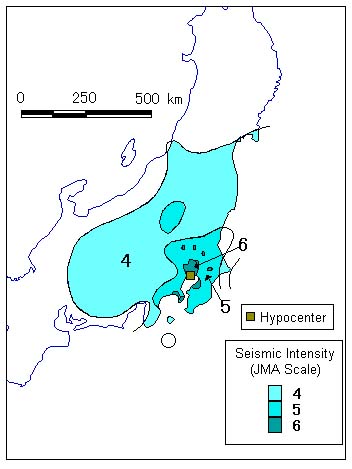
This earthquake occurred in a location deep under the eastern part of Tokyo, and is thought to have been within the subducted Pacific Plate. Strong ground motion was felt, particularly on the coast of Tokyo Bay. Ground motion corresponding to a seismic intensity of 5 in JMA scale was felt in eastern Tokyo, eastern Kanagawa Prefecture, southeastern Saitama Prefecture, and other locations. In some areas, there was ground motion corresponding to a seismic intensity of 6 in JMA scale (Fig.5-32). There was heavy damage along Tokyo Bay coast in Tokyo and Yokohama, as well as 31 fatalities in total (Fig.5-33). Cracks and liquefaction of the ground occurred throughout the affected areas.

The precision of observation equipment was still not advanced at this time. Therefore, of the earthquakes observed in this area within one year after the main shock, only the one (M 6.7) occurring three and a half months after the main shock is thought to be an aftershock.


Sunday, 11 March 2012

1855 Ansei Edo Quake quick notes.

Ansei Edo Quake 11th November 1855.

Magnitude: 7.0

Epicentre: Tokyo Bay. Now a built-up area. Closest station is Toyosu.
http://mapper.acme.com/?ll=35.65,139.8&z=11&t=M&marker0=35.65,139.8,1855%20Ansei%20Edo%20earthquake

Casualties: 7,000

Damage: Approx 50,000 houses detroyed by quake and subsequent fires.

Sites of interest

Japan Meteorological Association:
http://www.jma.go.jp/jma/en/menu.html


Home anti-seismic test:
http://www.kenchiku-bosai.or.jp/english/file/wagaya-e.pdf


Tokyo Govt. disaster prevention Info:

http://www.bousai.metro.tokyo.jp/english/e-athome/taishin.html


Future quakes. Quake research institute, Uni of Tokyo:
http://www.eri.u-tokyo.ac.jp/BERI/pdf/IHO81321.pdf


Quake Prediction Sites:
http://quakeprediction.com (updated daily)
http://geoq.ru/eindex.htm
I have followed these two sites for the past year, since 11 March, and have found that some of the predictions have been notable.


Headquarters for Earthquake Search Promotion:
http://www.jishin.go.jp/main/index-e.html


Global Disaster Watch:
http://globaldisasterwatch.blogspot.com/
Interesting blogspot that ran an interesting article here:
http://globaldisasterwatch.blogspot.com/2012/02/monday-february-20-2012.html


NASA Astropysics Database Systems:
http://adsabs.harvard.edu/cgi-bin/nph-basic_connect


Study and distribution of seismic intesity 1855 Ansei Edo quake:
http://library.jsce.or.jp/Image_DB/eq1994/proc/00037/380-0201.pdf

1855 Ansei Edo Quake

Regarding the 1855 Ansei Edo Earthquake (M 6.9), there are two ideas: first, it has been caused by active fault movement close to the surface; second, it has occurred on the upper surface of the Philippine Sea Plate.

The Ansei Edo Earthquake is thought to have occurred in a shallow or moderately deep area near the mouth of the Arakawa River (Ara Kawa). It generated strong ground motion over a wide area in the Kanto region, and its ground motion is estimated to have been the equivalent of seismic intensity 6 in JMA scale in eastern Tokyo, northwestern Chiba Prefecture, and eastern Saitama Prefecture (Fig.5-20 and Fig.5-21). This earthquake caused extensive fire damage over a wide area. Liquefaction of the ground is also known to have occurred in several locations. There were more than 7,000 fatalities in all. While there was no report of the tsunami generated by this earthquake, a large number of aftershocks are thought to haUve occurred (Fig.5-22). Historical data reveal that several phenomena occurred before the earthquake, including the spring of groundwater and ground rumbling.


About this blog

I was in Tokyo on the 11th March when the quake and tsunami struck the east coast of Japan.
I was on the train at the time when the immense shaking started...and went on...and on...and on.

Whilst the epicentre was a long way from Tokyo itself, it still wasn't the Big One that has been expected to hit the capital for years.

Confusingly, several quakes have been predicted and many reports have been written.

Quakes such the the 1923 Kanto quake, the Tokai quake, the 1855 Ansei Edo quake, and the 1894 Meiji quake.
The Tokai quake has been the one that the Japanese Govt. has been concentrating on and has been the focus of predictions.
This quake, whilst not having an epicentre in Tokyo, would cause damage to the city.

When a quake has been spoken of in and around the Capital, the Kanto quake has been the one that has been quoted by journalists in their reports.

Fresh research has scientists predicting the epicentre will be of that similar to the 1855 & 1894 quakes that struck in Tokyo Bay.
Scientists report that there is now a 70% chance of a Tokyo quake happening in Tokyo Bay area within 4 years.
So, after searching for information, it has led me to start this blog.
I aim to gather information from both of the Tokyo Bay quakes. Information about the Tokyo Bay quakes is hard to find as they happened at a time when technology wasn't as advanced.
I will also focus on the 1995 Kobe quake as a recent turn of events.
This quake has some interesting info that can in one way or another give us an idea what a quake in Tokyo might be like.

The Kobe quake was shallow and close to land. It was a 7.2 magnitude, which is roughly what is predicted in Tokyo.
Kobe is also a large industrial city.
However, the population is about a tenth of that of Tokyo's.
Still, as modern Japanese quakes go, Kobe is a good source of the potential devastation that is likely in Tokyo.

One of the things that I noticed when going onto some forums that there is a lot of fear-mongering and people giving the same information, over and over again.
It doesn't give one the best hope.
I'm gathering my information from history and compiling it into one blog.
It probably won't be a blog to seek help and advice on what to do in a quake, and I won't be telling anyone to stock up on dry food and fresh water, you should already know this.

Once again, this blog is about the predicted Tokyo Bay quake.